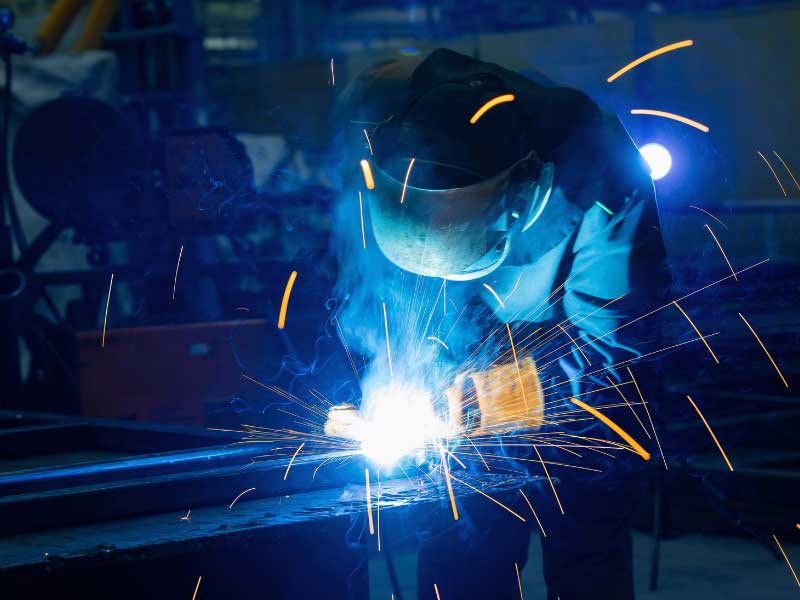
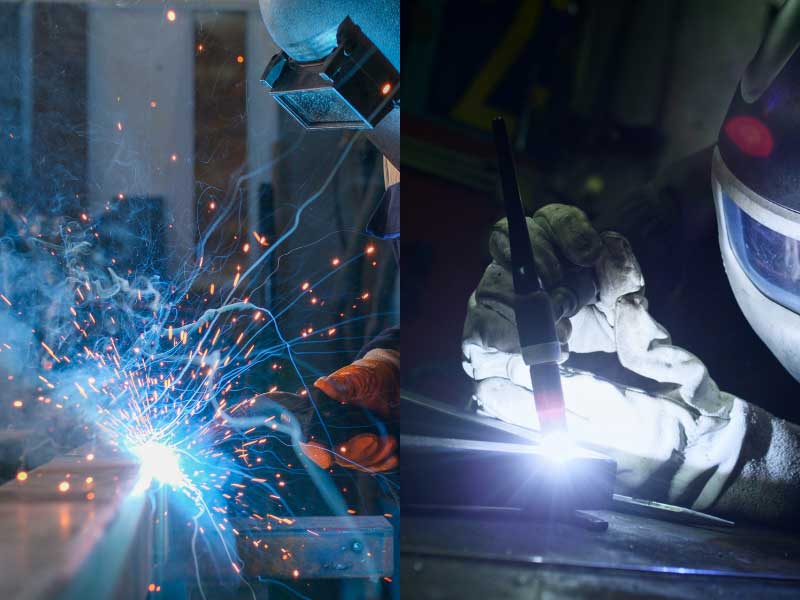
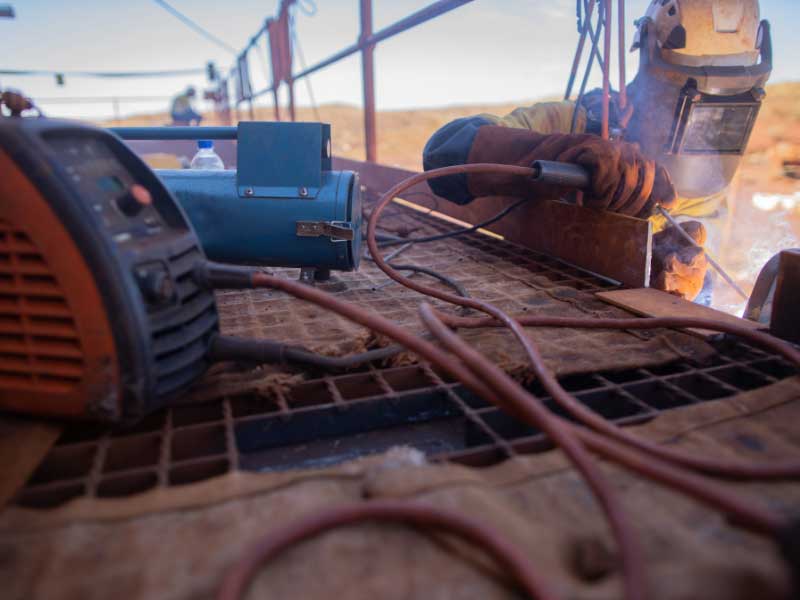
TIG and MIG welding are the two processes contractors reach for most on Australian construction and mine sites. MIG runs a continuous wire feed for fast, high-volume joins on thicker steel, while TIG uses a non-consumable tungsten electrode for a slower, more controlled weld on stainless steel, aluminium and thinner materials.
Which process wins depends on the material, the joint and the finish the job demands. We compare TIG vs MIG welders below, then browse our welder hire options to find the right machine for the job.
MIG welding feeds a continuous wire electrode through a handheld gun while a shielding gas protects the weld pool from contamination. It’s usually the first process contractors use, because it’s quick to learn and forgiving on thicker steel.
On a construction site, MIG suits structural steelwork, framework assembly and general fabrication, where speed and strength matter more than a mirror finish. A competent operator can run a long, continuous bead across a structural section with minimal stop-start, which keeps labour-intensive jobs on schedule.
TIG welding, also known as GTAW (gas tungsten arc welding), uses a non-consumable tungsten electrode and a separate filler rod, giving the operator close control over heat input and weld pool. It produces a cleaner, more precise weld than MIG, with far less spatter.
That control comes at a cost. TIG is slower, and it demands a more experienced operator working the torch, filler rod and foot pedal together. It’s the process of choice for stainless steel, aluminium and thin-gauge material, and for welds that need a visible, certification-grade finish, such as pipework.
The table below sets out how MIG and TIG welding stack up against each other on the factors that matter most on a construction or mine site.
Reach for MIG when the job calls for speed and volume. It’s the standard choice for structural steel framing, site fabrication, plant repairs, and any application joining mild or carbon steel quickly and reliably.
Because the wire feed runs continuously, MIG also handles longer welds without the stop-start of changing filler rods, which counts when a crew is working to a tight program.
TIG earns its place on site when the finish, the material or the certification requirement rules MIG out. Stainless steel handrails, aluminium fabrication, thin-gauge sheet metal, and pipe welds that need to pass a visual or NDT (non-destructive testing) inspection all call for the tighter control TIG offers.
It’s not the process for high-volume structural work, but for welds that have to be right the first time, the extra time on the tools is worth it.
MIG and TIG welders cover most site welding, but they’re not the whole story.
Stick welding, also called MMA (manual metal arc), uses a flux-coated electrode and needs no shielding gas, which makes it reliable in wind, rain, and on rusty or painted steel where MIG and TIG would struggle.
Flux-Cored welding runs a tubular wire with its own internal flux, giving high deposition rates for heavy structural work outdoors, again without relying on a clean gas shield.
Some sites also need to cut, gouge or prepare edges before welding starts. A handful of multi-process welders extend that far, using a carbon electrode and compressed air to cut a clean groove through steel. The question isn’t which single process wins. It’s which combination a crew actually needs on the one machine.
Every welder in the Onsite Rentals fleet runs MIG and TIG as standard, so switching processes mid-job never means waiting on a second machine. Some models go further, adding Flux-Cored welding or gouging for crews that need the extra capability on hand.
There’s no single winner in TIG welding vs MIG welding. MIG carries the volume, running fast, strong welds across structural steel and general fabrication. TIG carries the precision, holding up on stainless, aluminium and any joint that needs a certification-grade finish. Stick and Flux-Cored fill the gaps TIG or MIG welding can’t, welding through rust, paint and bad weather without a shielding gas to protect.
That’s the case for hiring a multi-process welder rather than a single-process machine. A crew moving between structural framing, pipework and site repairs shouldn’t need three different welders parked on site to get through the program.
Here at Onsite Rentals, our entire welder fleet is capable of both MIG and TIG as a minimum. Some models can also do Stick welding, Flux-Cored welding, and gouging.
[{"id":3939,"link":"https:\/\/www.onsite.com.au\/mig-vs-tig-welding-guide\/","name":"mig-vs-tig-welding-guide","thumbnail":{"url":"https:\/\/www.onsite.com.au\/wp-content\/uploads\/2026\/09\/mig-welding-steel-beams-workshop.jpg","alt":"Welder in protective helmet and gloves MIG welding steel beams, with bright arc and orange sparks flying in an industrial workshop"},"title":"MIG vs TIG Welding: What\u2019s the Difference?","author":{"name":"admin","link":"https:\/\/www.onsite.com.au\/author\/admin\/"},"date":"Sep 25, 2026","dateGMT":"2026-09-25 09:08:41","modifiedDate":"2026-09-25 09:09:02","modifiedDateGMT":"2026-09-25 09:09:02","commentCount":"0","commentStatus":"closed","categories":{"coma":"<a href=\"https:\/\/www.onsite.com.au\/category\/news\/\" rel=\"category tag\">News<\/a>","space":"<a href=\"https:\/\/www.onsite.com.au\/category\/news\/\" rel=\"category tag\">News<\/a>"},"taxonomies":{"post_tag":""},"readTime":{"min":6,"sec":28},"status":"publish","excerpt":""},{"id":3689,"link":"https:\/\/www.onsite.com.au\/portable-toilets-or-amenities-blocks\/","name":"portable-toilets-or-amenities-blocks","thumbnail":{"url":"https:\/\/www.onsite.com.au\/wp-content\/uploads\/2026\/02\/toilet-block-e1771824065640.jpg","alt":"A portable toilet on a construction site"},"title":"Mobile Toilets or Amenities Blocks? A Project Manager's Guide","author":{"name":"admin","link":"https:\/\/www.onsite.com.au\/author\/admin\/"},"date":"Feb 23, 2026","dateGMT":"2026-02-23 05:39:13","modifiedDate":"2026-02-23 05:46:34","modifiedDateGMT":"2026-02-23 05:46:34","commentCount":"0","commentStatus":"closed","categories":{"coma":"<a href=\"https:\/\/www.onsite.com.au\/category\/news\/\" rel=\"category tag\">News<\/a>","space":"<a href=\"https:\/\/www.onsite.com.au\/category\/news\/\" rel=\"category tag\">News<\/a>"},"taxonomies":{"post_tag":""},"readTime":{"min":5,"sec":37},"status":"publish","excerpt":""},{"id":3580,"link":"https:\/\/www.onsite.com.au\/10-questions-to-ask-about-equipment-for-hire\/","name":"10-questions-to-ask-about-equipment-for-hire","thumbnail":{"url":"https:\/\/www.onsite.com.au\/wp-content\/uploads\/2026\/01\/Blog_10-most-asked-questions-e1769136865113.jpg","alt":"Man operating a scissor lift on a job site"},"title":"10 Questions to Ask About Equipment for Rent","author":{"name":"admin","link":"https:\/\/www.onsite.com.au\/author\/admin\/"},"date":"Jan 23, 2026","dateGMT":"2026-01-23 02:46:39","modifiedDate":"2026-01-29 04:29:37","modifiedDateGMT":"2026-01-29 04:29:37","commentCount":"0","commentStatus":"closed","categories":{"coma":"<a href=\"https:\/\/www.onsite.com.au\/category\/news\/\" rel=\"category tag\">News<\/a>","space":"<a href=\"https:\/\/www.onsite.com.au\/category\/news\/\" rel=\"category tag\">News<\/a>"},"taxonomies":{"post_tag":""},"readTime":{"min":6,"sec":57},"status":"publish","excerpt":""},{"id":3489,"link":"https:\/\/www.onsite.com.au\/plan-equipment-hire-early-for-peak-construction-season\/","name":"plan-equipment-hire-early-for-peak-construction-season","thumbnail":{"url":"https:\/\/www.onsite.com.au\/wp-content\/uploads\/2025\/11\/Portable-Office.jpg","alt":"A prefabricated Onsite building module being lifted into place by a crane at work site, with workers guiding the unit onto concrete footings."},"title":"Don\u2019t Be Caught Short In Peak Season - Hire Construction Equipment Early","author":{"name":"admin","link":"https:\/\/www.onsite.com.au\/author\/admin\/"},"date":"Nov 18, 2025","dateGMT":"2025-11-18 02:20:49","modifiedDate":"2025-11-27 01:55:46","modifiedDateGMT":"2025-11-27 01:55:46","commentCount":"0","commentStatus":"closed","categories":{"coma":"<a href=\"https:\/\/www.onsite.com.au\/category\/news\/\" rel=\"category tag\">News<\/a>","space":"<a href=\"https:\/\/www.onsite.com.au\/category\/news\/\" rel=\"category tag\">News<\/a>"},"taxonomies":{"post_tag":""},"readTime":{"min":6,"sec":28},"status":"publish","excerpt":""},{"id":3222,"link":"https:\/\/www.onsite.com.au\/process-of-hiring-equipment\/","name":"process-of-hiring-equipment","thumbnail":{"url":"https:\/\/www.onsite.com.au\/wp-content\/uploads\/2025\/10\/BLog_Equipment_Hire1-scaled.jpg","alt":"A large Onsite energy pack connected to a generator running on a building site"},"title":"The Ideal Equipment Hire Process Explained","author":{"name":"admin","link":"https:\/\/www.onsite.com.au\/author\/admin\/"},"date":"Oct 17, 2025","dateGMT":"2025-10-17 09:22:42","modifiedDate":"2025-10-21 06:44:44","modifiedDateGMT":"2025-10-21 06:44:44","commentCount":"0","commentStatus":"closed","categories":{"coma":"<a href=\"https:\/\/www.onsite.com.au\/category\/news\/\" rel=\"category tag\">News<\/a>","space":"<a href=\"https:\/\/www.onsite.com.au\/category\/news\/\" rel=\"category tag\">News<\/a>"},"taxonomies":{"post_tag":""},"readTime":{"min":4,"sec":49},"status":"publish","excerpt":""},{"id":3008,"link":"https:\/\/www.onsite.com.au\/what-is-mine-site-accommodation-like\/","name":"what-is-mine-site-accommodation-like","thumbnail":{"url":"https:\/\/www.onsite.com.au\/wp-content\/uploads\/2025\/08\/August-2025_Blog_hero-scaled-e1763443323254.jpg","alt":"Quality Mining Accommodation for Hire"},"title":"What is Mine Site Accommodation Like?","author":{"name":"admin","link":"https:\/\/www.onsite.com.au\/author\/admin\/"},"date":"Aug 28, 2025","dateGMT":"2025-08-28 10:40:26","modifiedDate":"2025-08-29 02:51:48","modifiedDateGMT":"2025-08-29 02:51:48","commentCount":"0","commentStatus":"closed","categories":{"coma":"<a href=\"https:\/\/www.onsite.com.au\/category\/news\/\" rel=\"category tag\">News<\/a>","space":"<a href=\"https:\/\/www.onsite.com.au\/category\/news\/\" rel=\"category tag\">News<\/a>"},"taxonomies":{"post_tag":""},"readTime":{"min":4,"sec":39},"status":"publish","excerpt":""},{"id":3005,"link":"https:\/\/www.onsite.com.au\/trusted-equipment-hire-specialist\/","name":"trusted-equipment-hire-specialist","thumbnail":{"url":"https:\/\/www.onsite.com.au\/wp-content\/uploads\/2025\/08\/July2025_Blog_hero-scaled.jpg","alt":"24\/7 Equipment Hire Solutions"},"title":"Discover Smarter Equipment Hire With Onsite Rentals","author":{"name":"admin","link":"https:\/\/www.onsite.com.au\/author\/admin\/"},"date":"Aug 28, 2025","dateGMT":"2025-08-28 09:58:51","modifiedDate":"2025-08-29 02:46:00","modifiedDateGMT":"2025-08-29 02:46:00","commentCount":"0","commentStatus":"closed","categories":{"coma":"<a href=\"https:\/\/www.onsite.com.au\/category\/news\/\" rel=\"category tag\">News<\/a>","space":"<a href=\"https:\/\/www.onsite.com.au\/category\/news\/\" rel=\"category tag\">News<\/a>"},"taxonomies":{"post_tag":""},"readTime":{"min":5,"sec":13},"status":"publish","excerpt":""},{"id":2956,"link":"https:\/\/www.onsite.com.au\/choosing-the-right-portable-toilet-for-construction-sites\/","name":"choosing-the-right-portable-toilet-for-construction-sites","thumbnail":{"url":"https:\/\/www.onsite.com.au\/wp-content\/uploads\/2025\/08\/Right-Toilet-Hire-e1763514859512.png","alt":"Onsite Rentals toilet hire for construction site facilities"},"title":"How to Choose the Right Toilet Hire for Construction Sites","author":{"name":"admin","link":"https:\/\/www.onsite.com.au\/author\/admin\/"},"date":"Aug 27, 2025","dateGMT":"2025-08-27 02:46:28","modifiedDate":"2026-06-26 07:17:44","modifiedDateGMT":"2026-06-26 07:17:44","commentCount":"0","commentStatus":"closed","categories":{"coma":"<a href=\"https:\/\/www.onsite.com.au\/category\/news\/\" rel=\"category tag\">News<\/a>","space":"<a href=\"https:\/\/www.onsite.com.au\/category\/news\/\" rel=\"category tag\">News<\/a>"},"taxonomies":{"post_tag":""},"readTime":{"min":5,"sec":57},"status":"publish","excerpt":""},{"id":2941,"link":"https:\/\/www.onsite.com.au\/choosing-the-best-traffic-management-equipment\/","name":"choosing-the-best-traffic-management-equipment","thumbnail":{"url":"https:\/\/www.onsite.com.au\/wp-content\/uploads\/2025\/08\/Traffic-Management-e1754899760678.jpg","alt":""},"title":"What to Look for in Traffic Management Equipment Hire","author":{"name":"admin","link":"https:\/\/www.onsite.com.au\/author\/admin\/"},"date":"Aug 11, 2025","dateGMT":"2025-08-11 08:22:21","modifiedDate":"2025-08-28 11:31:17","modifiedDateGMT":"2025-08-28 11:31:17","commentCount":"0","commentStatus":"closed","categories":{"coma":"<a href=\"https:\/\/www.onsite.com.au\/category\/news\/\" rel=\"category tag\">News<\/a>","space":"<a href=\"https:\/\/www.onsite.com.au\/category\/news\/\" rel=\"category tag\">News<\/a>"},"taxonomies":{"post_tag":""},"readTime":{"min":3,"sec":44},"status":"publish","excerpt":""},{"id":2719,"link":"https:\/\/www.onsite.com.au\/ontelligent-enhancing-customer-experience-with-ai-powered-solutions\/","name":"ontelligent-enhancing-customer-experience-with-ai-powered-solutions","thumbnail":{"url":"https:\/\/www.onsite.com.au\/wp-content\/uploads\/2025\/07\/Revised-iMAGE-COMPRESSED-WITH-LOGO-NEW-e1763515044795.png","alt":""},"title":"Ontelligent: Enhancing Customer Experience with AI-Powered Solutions","author":{"name":"onsite","link":"https:\/\/www.onsite.com.au\/author\/onsite\/"},"date":"Jul 1, 2025","dateGMT":"2025-07-01 00:19:17","modifiedDate":"2025-08-29 02:48:16","modifiedDateGMT":"2025-08-29 02:48:16","commentCount":"0","commentStatus":"closed","categories":{"coma":"<a href=\"https:\/\/www.onsite.com.au\/category\/news\/\" rel=\"category tag\">News<\/a>","space":"<a href=\"https:\/\/www.onsite.com.au\/category\/news\/\" rel=\"category tag\">News<\/a>"},"taxonomies":{"post_tag":""},"readTime":{"min":2,"sec":29},"status":"publish","excerpt":""},{"id":2684,"link":"https:\/\/www.onsite.com.au\/blog-choosing-the-best-boom-hire-service\/","name":"blog-choosing-the-best-boom-hire-service","thumbnail":{"url":"https:\/\/www.onsite.com.au\/wp-content\/uploads\/2025\/06\/BestBoomLiftBlog-scaled-e1763514827321.jpg","alt":"Boom lift"},"title":"How to Choose the Right Equipment With Boom Lift Hire","author":{"name":"admin","link":"https:\/\/www.onsite.com.au\/author\/admin\/"},"date":"Jun 24, 2025","dateGMT":"2025-06-24 01:30:51","modifiedDate":"2025-08-29 10:59:20","modifiedDateGMT":"2025-08-29 10:59:20","commentCount":"0","commentStatus":"closed","categories":{"coma":"<a href=\"https:\/\/www.onsite.com.au\/category\/news\/\" rel=\"category tag\">News<\/a>","space":"<a href=\"https:\/\/www.onsite.com.au\/category\/news\/\" rel=\"category tag\">News<\/a>"},"taxonomies":{"post_tag":""},"readTime":{"min":4,"sec":17},"status":"publish","excerpt":""},{"id":2677,"link":"https:\/\/www.onsite.com.au\/blog-understanding-scissor-lift-hire\/","name":"blog-understanding-scissor-lift-hire","thumbnail":{"url":"https:\/\/www.onsite.com.au\/wp-content\/uploads\/2025\/06\/June2025_Blog_hero-2-e1763515742357.jpg","alt":"Scissor Lift"},"title":"Crucial Hire of Scissor Lift Requirements Before Investing","author":{"name":"admin","link":"https:\/\/www.onsite.com.au\/author\/admin\/"},"date":"Jun 24, 2025","dateGMT":"2025-06-24 01:29:37","modifiedDate":"2026-02-18 13:15:55","modifiedDateGMT":"2026-02-18 13:15:55","commentCount":"0","commentStatus":"closed","categories":{"coma":"<a href=\"https:\/\/www.onsite.com.au\/category\/news\/\" rel=\"category tag\">News<\/a>","space":"<a href=\"https:\/\/www.onsite.com.au\/category\/news\/\" rel=\"category tag\">News<\/a>"},"taxonomies":{"post_tag":""},"readTime":{"min":4,"sec":10},"status":"publish","excerpt":""},{"id":2534,"link":"https:\/\/www.onsite.com.au\/acquisition-of-road-safety-rentals-aus\/","name":"acquisition-of-road-safety-rentals-aus","thumbnail":{"url":"https:\/\/www.onsite.com.au\/wp-content\/uploads\/2025\/04\/Road-safety-Rentals.jpg","alt":"Road safety Rentals"},"title":"Acquisition of Road Safety Rentals (AUS)","author":{"name":"onsite","link":"https:\/\/www.onsite.com.au\/author\/onsite\/"},"date":"May 2, 2025","dateGMT":"2025-05-02 01:25:53","modifiedDate":"2025-05-02 01:25:55","modifiedDateGMT":"2025-05-02 01:25:55","commentCount":"0","commentStatus":"closed","categories":{"coma":"<a href=\"https:\/\/www.onsite.com.au\/category\/news\/\" rel=\"category tag\">News<\/a>","space":"<a href=\"https:\/\/www.onsite.com.au\/category\/news\/\" rel=\"category tag\">News<\/a>"},"taxonomies":{"post_tag":""},"readTime":{"min":0,"sec":33},"status":"publish","excerpt":""}]